


🕐 Read Time: 4 min
Last Update: October 2026
Dermatology EHR Pricing Guide for U.S. Clinics in 2026
Choosing a dermatology EHR is not simply a matter of comparing monthly subscription prices.
The total cost can depend on provider count, implementation, data migration, AI documentation, practice management, billing services, inventory, patient communication, analytics, additional locations, and other modules.
A system with a lower advertised monthly price can become more expensive once these costs are added. At the same time, a higher subscription price may include capabilities that would otherwise require several separate tools.
This guide explains how dermatology EHR pricing works, what can increase the overall cost, which fees practices should ask about, and how to compare vendor quotes based on total cost of ownership rather than the subscription price alone.
How Much Does Dermatology EHR Software Cost?
There is no single standard price for dermatology EHR software.
Pricing varies based on factors such as:
- Number of providers
- Number of locations
- EHR functionality
- Practice management
- AI documentation
- Billing and revenue cycle management
- Patient communication
- Inventory management
- Analytics
- Implementation
- Data migration
- Training
- Integrations
Some vendors publish subscription plans, while others provide custom quotes based on the size and requirements of the practice.
For dermatology practices, the important question is not only:
How much does the EHR cost per month?
It is also:
What does that price include, and what will we need to pay for separately?
For a broader comparison of clinical capabilities and platform fit, see our guide to dermatology EHR software.
The 3 Main Dermatology EHR Pricing Models
1. Per-Provider Monthly Pricing
One of the most common pricing models is a fixed monthly subscription for each provider.
The subscription may include:
- EHR access
- Practice management
- Scheduling
- Patient portal
- Basic reporting
- E-prescribing
Other capabilities may be sold separately depending on the vendor.
These can include:
- AI documentation
- Advanced analytics
- Inventory
- Patient communication
- Telehealth
- Billing services
- Additional locations
Per-provider pricing is relatively easy to understand, but practices should confirm exactly what is included before comparing two vendors based on the monthly amount alone.
2. Revenue Cycle Percentage Pricing
Some EHR vendors combine software with revenue cycle management services.
Instead of charging only a fixed software subscription, the vendor may charge a percentage of collections.
Services may include:
- Claims submission
- Insurance eligibility
- Payment posting
- Denial management
- Accounts receivable follow-up
- Patient billing
This model can reduce the need to maintain a separate billing vendor, but the overall cost may rise as practice revenue increases.
Practices should ask whether the percentage applies to:
- Insurance collections
- Patient collections
- Cosmetic revenue
- All practice revenue
- Specific service lines only
The agreement should clearly define what is included.
3. Hybrid or Modular Pricing
Some vendors combine a base subscription with additional modules.
The initial price may appear lower, but practices may pay separately for capabilities such as:
- AI documentation
- Scheduling
- Patient texting
- Inventory
- Analytics
- Telehealth
- Billing
- Multi-location support
This model can work well when a practice needs only a limited feature set.
However, it can become more expensive as the practice grows and adds more functionality.
What Determines Dermatology EHR Pricing?
Practice Size
A solo dermatologist will typically have different requirements from a multi-provider, multi-location group or hospital-based dermatology organization.
Pricing may increase based on:
- Providers
- Clinical users
- Administrative users
- Locations
- Patient volume
- Storage requirements
- Enterprise integrations
- Governance requirements
Practices should also check whether nurses, medical assistants, billers, front-desk users, and other staff are included or charged separately.
AI Documentation
AI documentation is increasingly part of the EHR buying decision.
Depending on the vendor, it may be:
- Included in the subscription
- Sold as a separate module
- Charged per provider
- Charged based on usage
Practices should also determine what the AI actually does.
There is a difference between:
- Transcription
- Ambient documentation
- Structured note generation
- Coding assistance
- Workflow automation
When comparing prices, evaluate the workflow rather than simply whether the vendor advertises an AI feature.
For a closer look at this area, see the AI documentation workflow for dermatology.
Practice Management
Some EHR packages include practice management, while others price it separately.
Practice management may include:
- Scheduling
- Online booking
- Intake
- Eligibility
- Reminders
- Tasks
- Referrals
- Claims
- Patient payments
- Reporting
A dermatology practice should determine whether these capabilities are part of the quoted subscription or require additional modules.
See our dermatology practice management software guide for a more detailed look at these workflows.
Billing and Revenue Cycle Management
Billing can significantly affect total EHR cost.
Ask whether the vendor charges separately for:
- Clearinghouse services
- Claims submission
- Eligibility
- Denial management
- Payment posting
- RCM services
- Patient statements
Also determine whether RCM is optional or tied to the software agreement.
For organizations with internal billing teams, a bundled RCM model may not always be necessary.
Inventory Management
Cosmetic dermatology practices may need to manage:
- Injectables
- Fillers
- Biologics
- Skincare products
- Procedure supplies
- Lot numbers
- Expiration dates
Some vendors include inventory capabilities, while others sell them as a separate module.
Organizations offering injectables should also check whether product usage connects directly to the patient encounter and whether inventory can be tracked across locations.
For more detail, see the dermatology inventory tracking guide.
Patient Communication
Patient communication may be included in the subscription or charged separately based on usage.
Possible costs include:
- SMS
- Phone
- Appointment reminders
- Two-way messaging
- Patient portal access
Ask whether messaging has:
- Monthly limits
- Per-message charges
- Separate phone charges
- Usage tiers
These costs can become meaningful for higher-volume practices and larger organizations.
Analytics and Reporting
Basic reporting may be included, while advanced analytics can require a higher-tier plan.
Organizations should determine whether they can analyze:
- Revenue
- Denials
- Provider performance
- No-shows
- Appointment volume
- Medical vs cosmetic revenue
- Inventory
- Multi-location performance
- Department-level performance
- Enterprise trends
Also ask whether custom reporting is included or requires additional services.
Multi-Location and Enterprise Support
Organizations operating across multiple locations, departments, or hospital systems should confirm whether each additional site carries a separate fee.
Also determine whether the platform supports:
- Centralized scheduling
- Shared patient records
- Location-specific inventory
- Location-level reporting
- Staff permissions
- Provider scheduling across sites
- Enterprise user management
- Integration requirements
- Organization-wide analytics
The cost difference can become significant as the organization expands.
Implementation and Setup Costs
Implementation is an important part of the total cost of a new EHR.
Possible implementation expenses include:
- System configuration
- Data migration
- Template setup
- Interface configuration
- User training
- Workflow configuration
- Testing
- Go-live support
- Enterprise integration work
The cost and complexity depend heavily on the organization’s existing systems and the amount of information being transferred.
A practice moving only patient demographics will have a different migration project from an organization transferring:
- Clinical notes
- Images
- Insurance information
- Billing history
- Documents
- Medications
- Allergies
- Appointments
- Historical pathology data
- Enterprise interfaces
Ask vendors to clearly separate implementation costs from recurring subscription fees.
Data Migration Costs
Data migration is often overlooked during initial pricing discussions.
Before signing a contract, ask:
- What data will be migrated?
- Are clinical images included?
- Will historical notes transfer?
- Is billing history included?
- Are documents transferred?
- How far back will the vendor migrate?
- Is data cleanup included?
- Is migration included in the subscription?
- Are additional migration fees charged?
- Are interfaces or legacy systems included in the migration scope?
For dermatology organizations, clinical images and historical lesion information can be particularly important.
See our Dermatology EHR Data Migration Guide for a more detailed breakdown.
Hidden Costs to Ask About
A low advertised price does not always mean a low total cost.
Before comparing vendors, ask about the following.
AI Add-Ons
Is AI documentation included or priced separately?
Messaging Fees
Are SMS and phone services included, limited, or usage-based?
Clearinghouse Fees
Are claims transmission and eligibility services included?
Inventory Modules
Is dermatology inventory management part of the standard package?
Analytics
Are advanced dashboards included?
Additional Locations
Is there a separate fee for every clinic, department, or hospital site?
Additional Users
Are nurses, billers, medical assistants, front-desk users, administrators, and enterprise users included?
Training
Is initial and ongoing training included?
Support
Is customer support included, or is premium support a separate plan?
Data Storage
Are clinical images or documents subject to storage limits?
Payment Processing
What transaction fees apply to patient payments?
Data Export
Is there a fee to export practice data if the contract ends?
Contract Termination
Does the agreement include early termination fees or minimum contract periods?
Enterprise Integrations
Are hospital interfaces, third-party integrations, or custom connections included or billed separately?
Total Cost of Ownership for a Dermatology Practice
Total cost of ownership includes more than the monthly software subscription.
A complete comparison should account for:
Total Cost of Ownership = Software subscription + Implementation + Data migration + Add-on modules + Messaging + Payment processing + Billing or RCM + Additional locations + Training + Support + Other recurring fees
Organizations should also consider the operational impact of the software.
For example, if one system requires separate tools for scheduling, AI documentation, inventory, patient communication, and reporting, the cost of those products should be included in the comparison.
The same applies to staff time. If employees spend significant time moving information between systems, reconciling reports, or completing tasks manually, that operational effort contributes to the real cost of running the platform.
A lower monthly subscription does not always result in a lower total cost. Comparing the full three-year cost of each platform can provide a more accurate picture of long-term value.
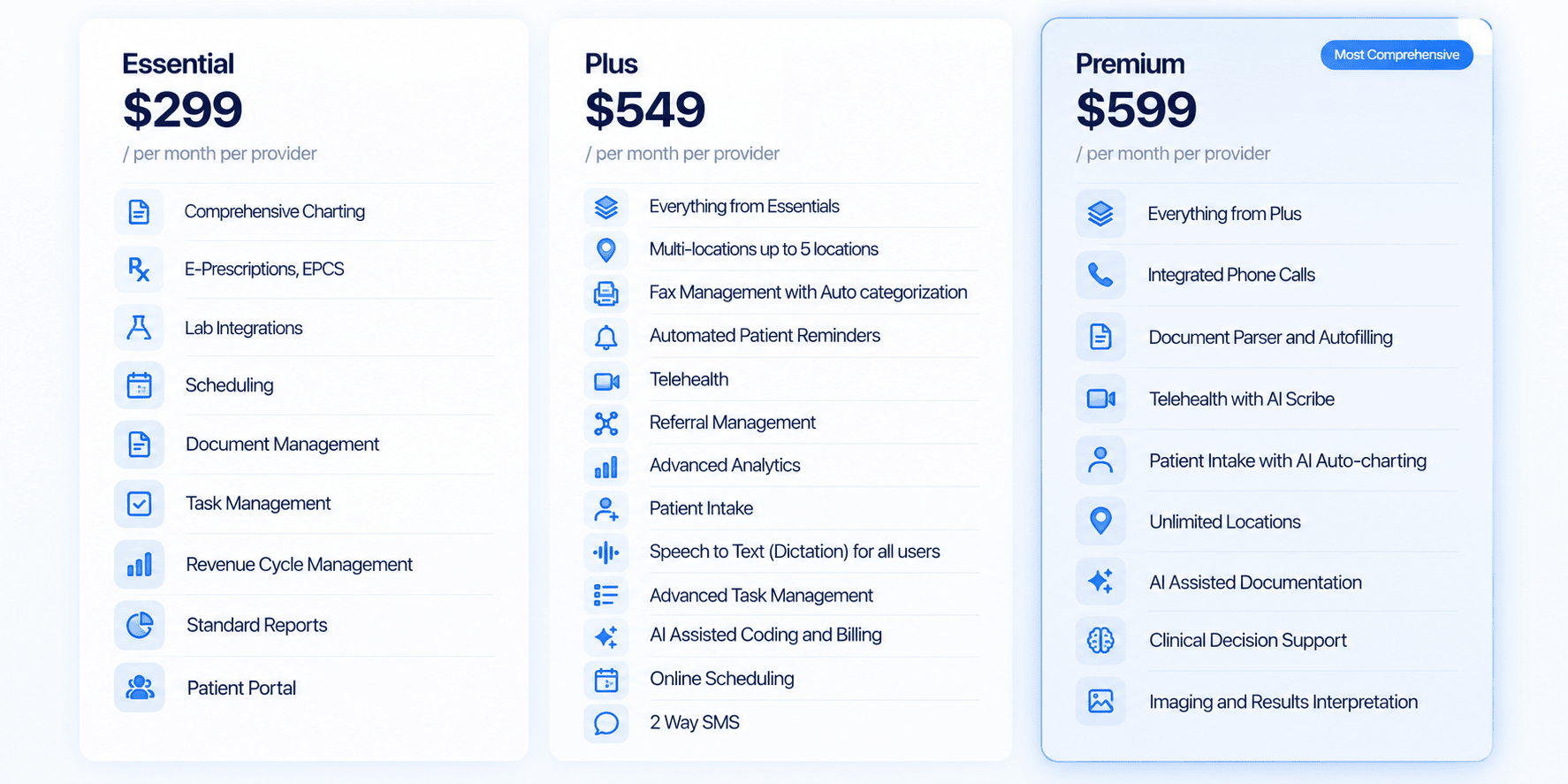
How Major Dermatology EHR Vendors Approach Pricing
Pricing structures vary significantly across dermatology EHR vendors.
The most useful comparison is not simply which vendor has the lowest advertised price, but how each vendor packages its software, modules, services, and implementation.
ModMed
ModMed is an established specialty-focused platform with dermatology capabilities.
Pricing is generally provided through a vendor quote and can depend on the products, modules, services, implementation requirements, and practice configuration selected.
Organizations evaluating ModMed should ask which capabilities are included in the quoted package and which require separate products or services.
EZDERM
EZDERM focuses specifically on dermatology workflows.
Pricing should be confirmed directly with the vendor based on the organization’s requirements.
Practices should ask how clinical functionality, practice management, billing, integrations, implementation, and other modules are packaged within the quote.
Nextech
Nextech serves dermatology and aesthetic practices and generally provides pricing based on selected products and practice requirements.
Organizations should request a complete breakdown covering software, implementation, integrations, additional modules, and ongoing services.
DrChrono
DrChrono has historically used tiered software plans, with functionality varying by plan and package.
Practices should confirm current pricing directly and identify which tier is required for the specific dermatology workflows they need.
AdvancedMD
AdvancedMD provides EHR, practice management, billing, and revenue cycle capabilities.
Pricing can depend on the software configuration and whether additional billing or RCM services are selected.
Organizations should request a written quote that separates software and service fees.
Edvak
Edvak is designed for healthcare organizations of all sizes, from independent dermatology practices and multi-location groups to large hospitals and health systems.
The AI Native Platform brings EHR, practice management, billing, patient engagement, AI-assisted workflows, analytics, and specialty-specific operations into one connected environment.
Organizations should review the current Edvak pricing page and request a written quote based on provider count, locations, workflow requirements, integration needs, and services.
Pricing, packaging, implementation, and included modules can change across all vendors. Organizations should request current written quotes directly from each vendor before comparing total cost.
How to Compare Dermatology EHR Vendor Quotes
Do not compare only the headline monthly price.
Ask each vendor to provide the same information.
| Cost Area | What to Ask |
|---|---|
| Base subscription | What is the monthly cost per provider or organization? |
| Practice management | Is it included? |
| AI documentation | Included or additional? |
| Scheduling | Included or separate module? |
| Patient intake | Included? |
| Messaging | Are there usage charges? |
| Billing | Software fee or percentage of collections? |
| Clearinghouse | Included or additional? |
| Inventory | Included or separate? |
| Analytics | Included at this tier? |
| Additional locations | Is there a location fee? |
| Implementation | What is the one-time cost? |
| Data migration | What data is included? |
| Training | Included or additional? |
| Payments | What processing fees apply? |
| Support | Included or premium? |
| Integrations | Are interfaces billed separately? |
| Data export | Is there a fee? |
| Contract | What is the term and cancellation policy? |
Once these numbers are available, compare the cost across at least three years rather than focusing only on the first month’s subscription.
Edvak Dermatology EHR Pricing
Edvak is designed for healthcare organizations of all sizes, including independent practices, growing groups, multi-location organizations, hospitals, and health systems.
Depending on the selected plan, configuration, and organization requirements, Edvak capabilities can include:
- AI-assisted documentation
- Practice management
- Scheduling
- Patient intake
- Patient reminders
- Two-way communication
- Coding assistance
- Eligibility
- Claims management
- Analytics
- Inventory
- Patient payments
- Multi-location support
- Enterprise workflows
- Specialty-specific functionality
Because pricing and plan availability can change, organizations should use the current Edvak pricing page as the source of truth for subscription pricing and included capabilities.
When requesting a quote, ask for all recurring and one-time fees separately so the total cost can be compared with other vendors on an equivalent basis.
What to Ask Before Signing a Dermatology EHR Contract
What Is Included in the Base Subscription?
Ask for a written list of included capabilities rather than relying only on the sales demonstration.
Which Features Cost Extra?
Specifically ask about:
- AI
- Inventory
- Analytics
- Messaging
- Scheduling
- Patient intake
- Additional locations
- Enterprise integrations
What Will Implementation Cost?
Request a clear breakdown of:
- Configuration
- Training
- Migration
- Interfaces
- Go-live support
What Data Will Be Migrated?
Make sure clinical information and dermatology-specific data are included where required.
Are Billing Services Optional?
Determine whether the EHR can be purchased without outsourced RCM if your organization already has a billing team.
What Happens as the Organization Grows?
Ask what happens to pricing when you add:
- Providers
- Locations
- Users
- Departments
- Services
- Patient volume
- Integrations
What Happens if We Leave?
Ask how data export works, how long records remain available, and whether export or termination fees apply.
Frequently Asked Questions About Dermatology EHR Pricing
How Much Does Dermatology EHR Software Cost?
Pricing varies depending on provider count, organization size, included modules, implementation requirements, billing services, AI capabilities, integrations, and contract structure.
Organizations should compare complete written quotes rather than monthly subscription prices alone.
Why Does Dermatology EHR Pricing Vary Between Vendors?
Different vendors bundle capabilities differently.
One subscription may include scheduling, intake, inventory, analytics, and AI documentation, while another may charge separately for each feature.
Billing, implementation, and enterprise integration models can also affect total cost.
Are AI Features Usually Included in EHR Pricing?
It depends on the vendor and plan.
Some platforms include AI capabilities, while others sell AI documentation or ambient scribe functionality as an additional module.
Ask specifically what AI capabilities are included in the quoted price.
Do Dermatology EHR Vendors Charge Implementation Fees?
Some vendors charge separately for implementation, training, migration, and interface setup.
Others include some or all of these services in the subscription or contract.
Ask for implementation costs to be listed separately.
What Hidden Costs Should Dermatology Organizations Look For?
Common areas to investigate include:
- Messaging
- Clearinghouse fees
- Billing services
- AI
- Inventory
- Analytics
- Additional locations
- Payment processing
- Data storage
- Training
- Support
- Data export
- Enterprise integrations
Do Cosmetic Dermatology Practices Need Inventory Management?
Practices offering injectables, retail products, or other stocked treatments may benefit from inventory management connected to the patient workflow.
When comparing EHR pricing, determine whether inventory functionality is included or sold separately.
How Should a Small Dermatology Practice Compare EHR Costs?
Start by defining the workflows the practice actually needs.
Then ask each vendor to quote the same configuration.
Compare:
- Subscription
- Implementation
- Migration
- Billing
- Messaging
- AI
- Inventory
- Analytics
- Support
Finally, compare the total cost over multiple years.
How Should a Large Dermatology Group or Hospital Compare EHR Costs?
Larger organizations should also evaluate:
- Enterprise integrations
- Multi-location support
- Role-based access
- Reporting acrossdepartments
- Implementation resources
- Interface costs
- Data migration scope
- Governance requirements
- Support structure
The lowest per-provider price may not represent the lowest total cost for a large organization.
Is the Cheapest Dermatology EHR Always the Best Value?
Not necessarily.
A lower subscription can become more expensive if the organization needs several additional tools, modules, integrations, or manual processes.
The better comparison is the total cost of running the complete workflow.
Look Beyond the Monthly Subscription
Dermatology EHR pricing should be evaluated as a complete operating cost, not simply a monthly software fee.
Before making a decision, understand:
- What is included
- What costs extra
- What implementation requires
- What migration includes
- How billing is priced
- How pricing changes as the organization grows
- What integrations cost
- What it costs to leave the platform
The strongest comparison is one where every vendor is asked to quote the same requirements.
For dermatology organizations evaluating both cost and workflow fit, start with the broader Best Dermatology EHR Software for U.S. Practices in 2026 guide, then use written vendor quotes to compare total cost.
Ready to take the next step?
Get a personalized demo and see how Edvak can drive real impact to your practice.
Related Blogs




More Categories
Edvak.com Terms & Conditions Privacy Policy © 2026 Edvak. All rights reserved.